Rolling laptop bag or rolling backpack: which one for your route
Both take the laptop off your shoulder and put it on wheels, and people buy the wrong one for the same reason every time: they choose by the bag and not by the route. Where the stairs are, how long the corridor is, whether there is a kerb between the car and the door, and whether the bag has to be worn for any part of the day is what decides it.
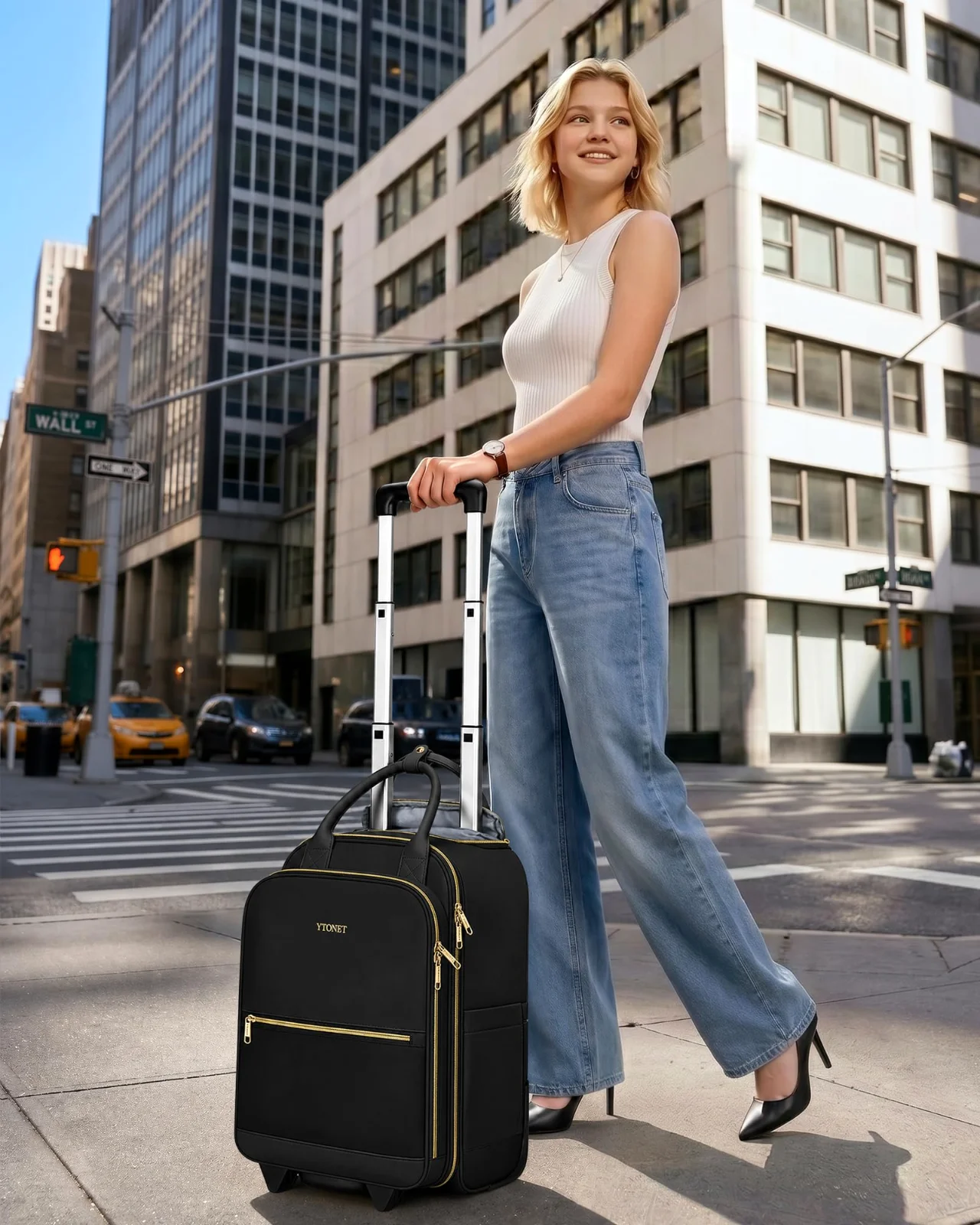
Start with the route, not the photograph
A bag can look right in a photograph and still be wrong for the morning you actually travel. The route decides more than the shape, colourway or number of pockets. Before you choose between our rolling laptop bags and rolling backpacks, picture the ground beneath your feet.
Where are the stairs between your front door and your desk? Count the flights, including the short steps at a station entrance or office doorway. A rolling bag can follow a level corridor, but stairs ask you to lift it or change how you carry it.
How long is the corridor you cross before you reach a lift, platform or meeting room? A long, clear stretch gives two wheels room to follow behind you. A crowded route may make a bag worn on your back easier to place and move.
Is there a kerb between the car and the door? Two wheels tip back and follow over a kerb, a gravel path or a bus step, but the bag needs to be tipped. That movement is different from pulling it flat behind you.
Will you wear the bag for any part of the day? A shoulder strap is not the same as backpack straps, and neither changes the route itself. The useful question is where your hands need to be free, and how often the bag leaves the floor.
Write down the answers. Then add the laptop size, the files or supplies you carry, and any train, bus or flight in the day. Our range is easier to narrow once the route is visible.
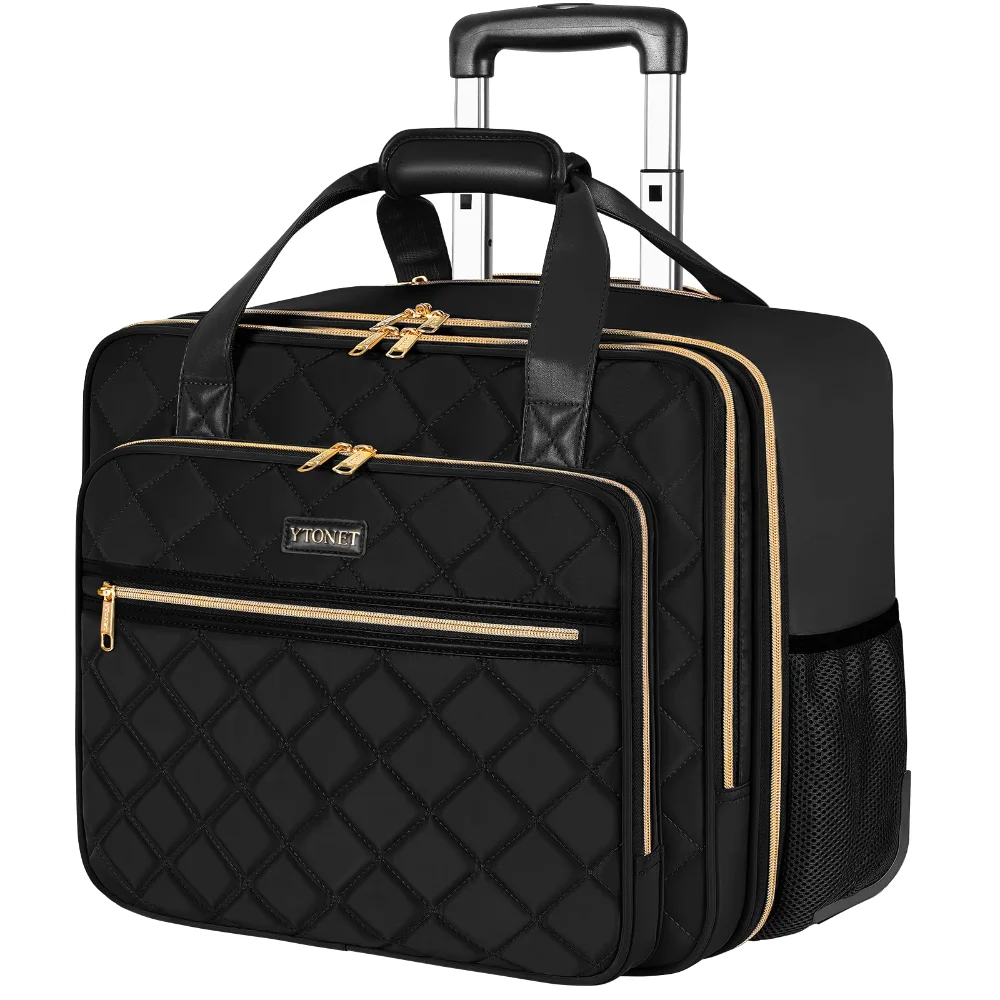
YTONET 17.3-inch Rolling Laptop Bag, with lock
Padded laptop sleeve · Two wheels, telescopic handle · Combination lock
$59.99
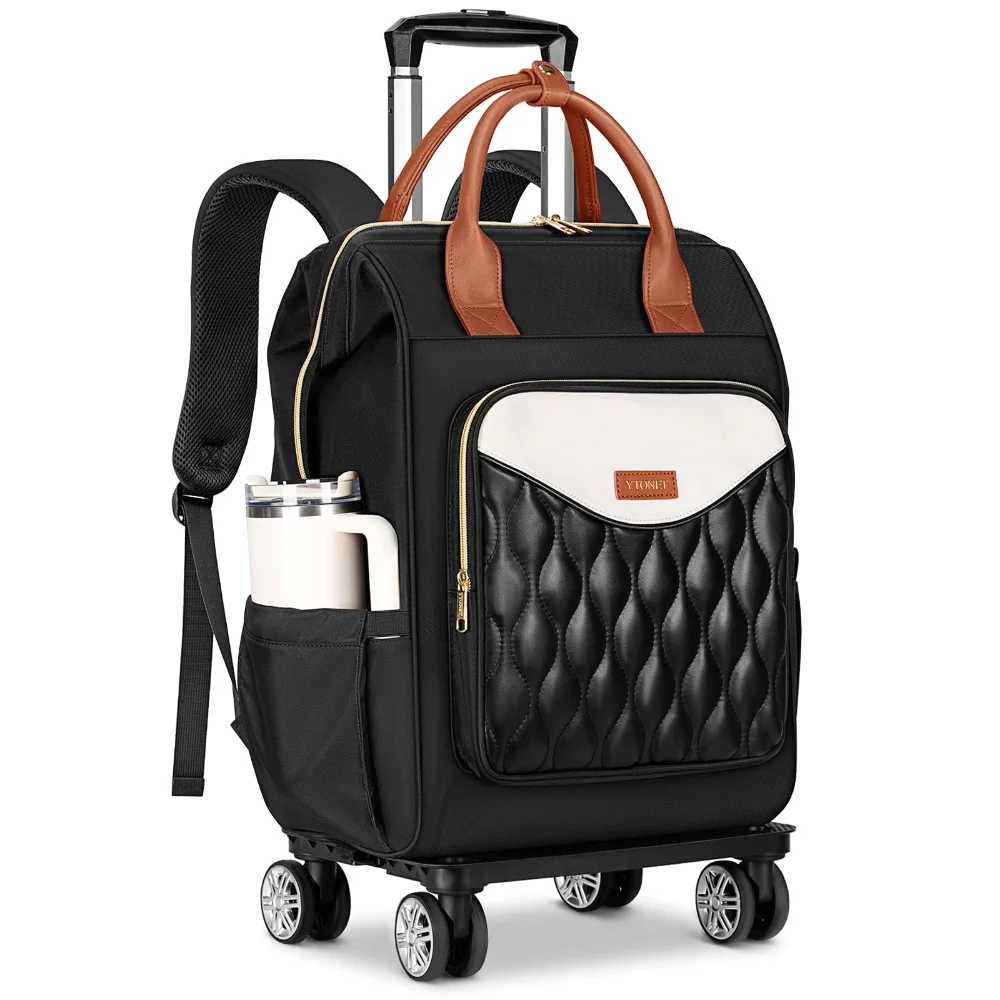
YTONET 15.6-inch Rolling Backpack, four spinner wheels
Padded laptop sleeve · Four spinner wheels · Water-resistant
$69.99
What a rolling laptop bag does well
Our rolling laptop bags are built around a simple movement: tip the bag back, pull it on two rubber wheels, then set it upright when you stop. The aluminium telescopic handle locks at each stop and collapses into a sleeve on the back. With the handle down, the bag stands upright on its own.
Inside, the padded laptop sleeve sits against the wheel side. Files go in front of it, so the computer and documents occupy separate parts of the main load. A strap on the back slides over a suitcase handle, giving the bag a place on top of another case during a journey.
That arrangement suits a route with corridors, pavements and short crossings between transport. It does not take a staircase on its own. You lift it by its handles, and a bus step needs the same decision. The two-wheel frame tips rather than climbing flat.
The fronts differ, so think of them as three working days. One 17.3-inch bag has a three-digit combination lock and an anti-theft pocket on the back panel. Another has a cup holder in the side for a route where a drink needs a set place. The 15.6-inch teacher bag has a detachable insulated lunch carrier, a cup holder and a trolley that comes off, leaving the bag to be carried upstairs by its handles.
The 17.3-inch lock bag measures 16.5 by 10.2 by 15 inches. Check the laptop size first, then match the front to the day you carry.
What a rolling backpack changes
A rolling backpack gives you two ways through the same route. Pull it on its trolley across a corridor, then put it on your back when stairs, a bus step or a busy doorway interrupts the floor. The padded, adjustable shoulder straps sit behind a zipped panel when the bag is being pulled, so they stay out of the way.
Every backpack in our range has a strap on the back for a suitcase handle and water-resistant cloth. Most run on two rubber wheels. One has four spinner wheels, and its whole trolley detaches at a door. That model is made for a route where the final section needs a bag without its rolling frame.
The frame lets the backpack stand up when you stop, while the straps create a second option for the parts that wheels cannot handle alone. A flight of stairs changes the choice. So does a bus where you need to lift quickly, or a train carriage with little space behind your heels.
The four-spinner backpack belongs to a different kind of route. Its wheels run flat beside you on a terminal floor, with no weight on the wrist, but a spinner on gravel stops. It is not the choice for every surface.
Our rolling backpacks are cut for a 15.6-inch laptop, with one designed for a 17.7-inch laptop. The 17.7-inch model measures 13 by 8 by 17.7 inches and holds 30 litres. Another 15.6-inch model measures 17.2 by 13.2 by 7.5 inches. Start with the space you need, then decide how often the straps will come out.
Two wheels or four
The wheel count matters because the route changes the way the bag moves. Two wheels tip the bag back, while four spinners run beside you on a level surface. Neither arrangement removes stairs, gravel or kerbs from the journey.
| Route type | What wins | Reason |
|---|---|---|
| Kerb and gravel | Two wheels | You can tip the bag back over the kerb and along a gravel path. |
| Tiled corridor | Four spinners | The bag runs flat beside you, with no weight on the wrist. |
| Bus and train | Two wheels or backpack straps | Two wheels follow a bus step when tipped, while straps help when you need to lift. |
| Terminal | Four spinners | A level terminal floor suits wheels that run beside you. |
| A child's school | A rolling backpack, if allowed | It can be carried on padded straps or rolled when the pack is too heavy. |
A two-wheel bag needs a little space behind you. Its handle extends into the route, and the bag follows at an angle. That motion suits a kerb, gravel or a bus step because the wheels meet the change in level together.
Four spinners ask for a smoother surface. They can move beside you on tiled flooring, but a spinner on gravel stops. The flat position also means you do not tip the bag back, which changes how you hold it while walking.
A rolling backpack covers more situations because its padded straps are available for stairs. The school row comes with an important condition. The American Academy of Pediatrics says a rolling backpack is an option when a pack is too heavy, if the school allows it. Follow the school's own rule before choosing that route.
Let the load decide too
The route is only half the choice. The load changes how each bag behaves, especially when the laptop is the one item at the front.
The American Academy of Pediatrics says a school backpack should not weigh more than 15 per cent of the child's body weight. Its guidance recommends two broad padded straps, a padded back and a waist or chest strap. It also says the heaviest items should go nearest the back, and names a rolling backpack as an option when a pack is too heavy, if the school allows it.
For an adult who has never weighed a bag, the first useful step is simple: weigh the loaded bag before deciding how it should travel. The 15 per cent figure is guidance for a child's school backpack, not a rule to apply to every adult load. It can still prompt a closer look at what is being carried each day.
Place the heaviest item nearest the back when the bag is worn. In a rolling laptop bag, the padded laptop sleeve sits against the wheel side, with files in front of it. That gives the bag a defined order, but a laptop alone in the front pocket can affect the balance. One buyer noted that the rolling laptop bag tipped forward in that arrangement.
The answer is not to add weight without purpose. Pack the laptop in its sleeve, consider what sits in front of it, and test the bag on the actual route. A teacher carrying supplies for a twelve-hour shift may need a different load plan from someone carrying a laptop and a few files.
Take the flight into account
A route can begin at home and end at a terminal. The Federal Aviation Administration says the maximum carry-on size for most airlines is 45 linear inches, meaning the total of height, width and depth. The airline sets the limit that applies, and some airlines are stricter.
Measure the bag you plan to take, rather than relying on its laptop size. Our 17.3-inch rolling bag with the lock measures 16.5 by 10.2 by 15 inches, which adds to 41.7 linear inches. The 17.7-inch rolling backpack measures 13 by 8 by 17.7 inches, which adds to 38.7 linear inches. These figures do not replace the airline's own limit.
The FAA says heavy items should go under the seat in front rather than overhead. It also says bag straps should be tucked in to avoid a tripping hazard. A rolling backpack's shoulder straps belong behind the zipped panel when the bag is pulled, then come out when you need to carry it.
Gate-checking changes the laptop question. The FAA says lithium-battery devices such as laptops come out of a bag that is gate-checked. Keep the laptop accessible, and know how the bag opens before you reach the gate.
For a terminal with smooth flooring and a long walk, choose four spinners if you want the bag beside you and the route has no gravel. For kerbs, gravel and bus steps, choose two wheels. If stairs are part of the day, choose a rolling backpack and use its straps, or choose the teacher bag when its detachable trolley suits the load. If the route is mostly corridors with files and a laptop, a rolling laptop bag gives you an upright stop and a defined laptop compartment.
The route is the recommendation. Let the bag follow it.
More of this sort of thing is in the Journal, the YTONET desk keeps the whole range one click away on the front page, and the sources behind every checkpoint and carry-on statement are listed on how we update the catalogue.